On Fahrenheits and Parabolas
My grandmother passed away last month, so I was down in India for ten days or so, not really studying (or in the mood to). Getting back, I found it difficult to get back on the horse. I consider the last month to have been a wash out.
I did do some work on the graphing and elementary geometry/trigonometry chapters, and then was having fun with Octave, so this is what that post is about.
Converting Fahrenheit to Celsius
Conversion from °F to °C is a linear equation, and it is often introduced in books of Algebra. We all know that at 40°C we are also at 40°F, for example. Or that water boils at 100°C and 212°F. Using values like these, we can easily derive the equation for the conversion between F to C, which is thus:
$${}^\circ F = \frac{9}{5} {}^\circ C + 32 $$
This is not interesting. But we are often told that a good rule of thumb to go from Celsius to Fahrenheit is “double the °C, then add 30”:
$${}^\circ F = 2 \cdot {}^\circ C + 30$$
This is also not interesting.
What I wanted to know was how much is the error in this simplification? Well the answer is below:
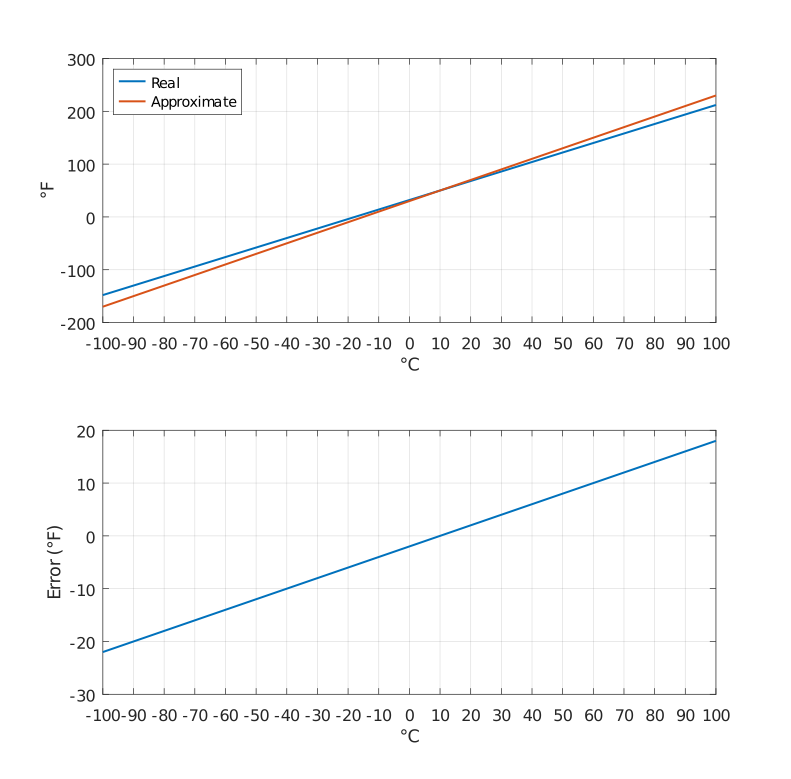
The main thing to note is that, at 10°C, the values are exact. There is no error. In both cases, you arrive exactly at 50°F. Beyond that, the approximation has a bit higher slope than the real conversion, so you underpredict the F before that, but exaggerate the real temp above it.
You’ll also see on the scale of the error plot that, very quickly, we can end up being 20°F off the real values. Our interest, however, is vaguely in the realm of ‘meterological’ temperatures, especially in a United States context. If we take Maryland, it sees temperatures between about -10°C and 40°C, exaggerating the end points for the sake of illustration. In this domain, we’re off by less than 10°F. This works out pretty well because I’ve never known an American who didn’t speak about the weather rounding up to the nearest 10°F anyway.
On Parabolic mirrors
The angle of incidence equals the angle of reflection. But does this mean that any incoming rays (parallel to the axis) pass through the focus? I wrote a script to see this.
Here’s my parabolic mirror below.
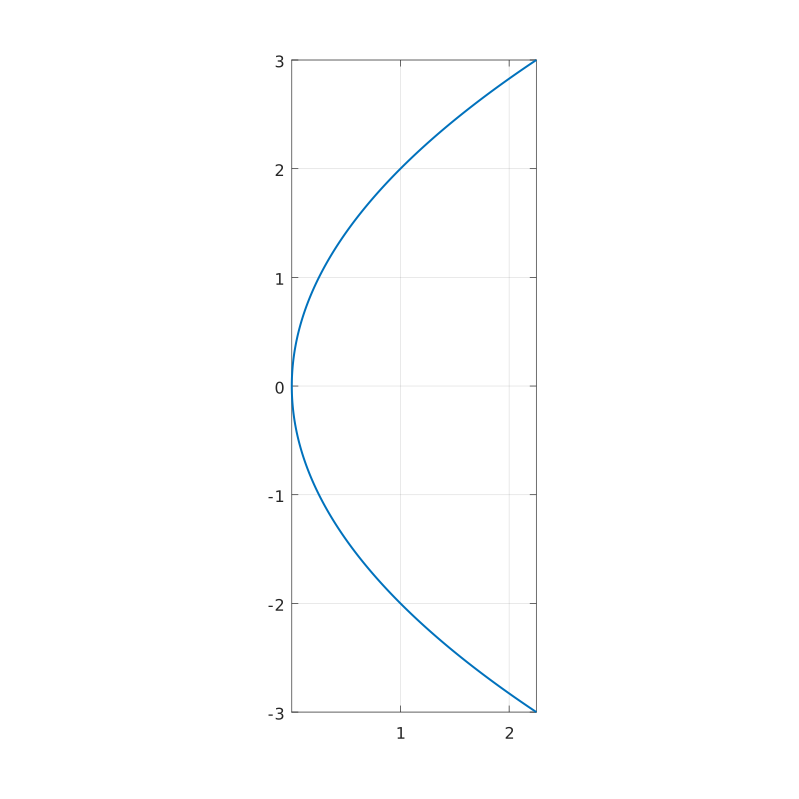
It has the equation of
$y^2 = 4 \cdot 1 \cdot x$,
written in this weird way to emphasise that p = 1. We know that p
is the point of focus, and I wanted a parabola where the rays
would pass through $x = 1$. We
now take a ray that comes and hits the parabola at y = 1.5, as
shown below. 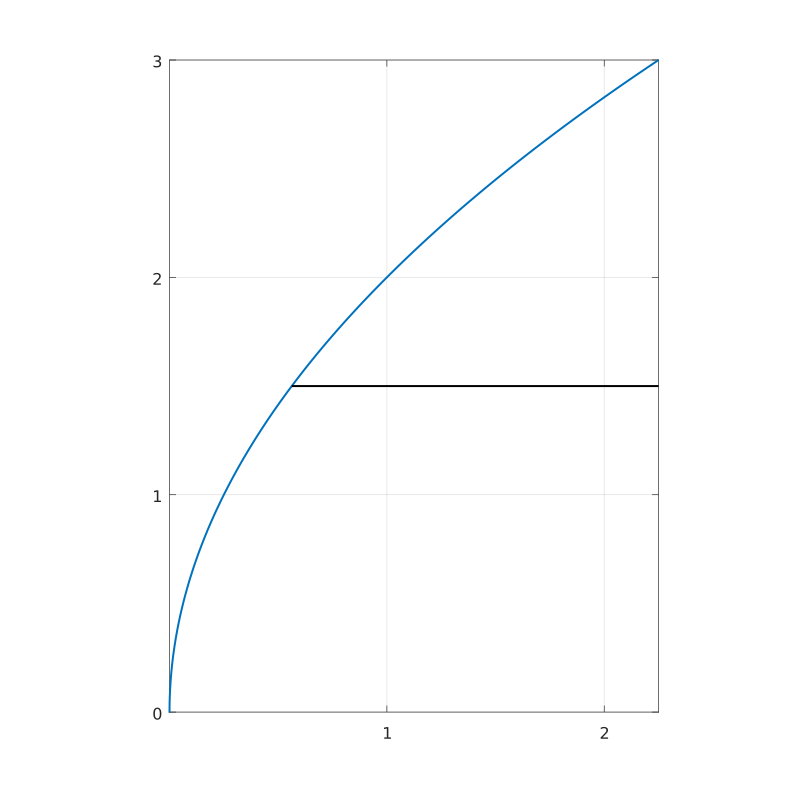 Next, we
draw the tangent at where it meets the parabolic mirror:
Next, we
draw the tangent at where it meets the parabolic mirror: 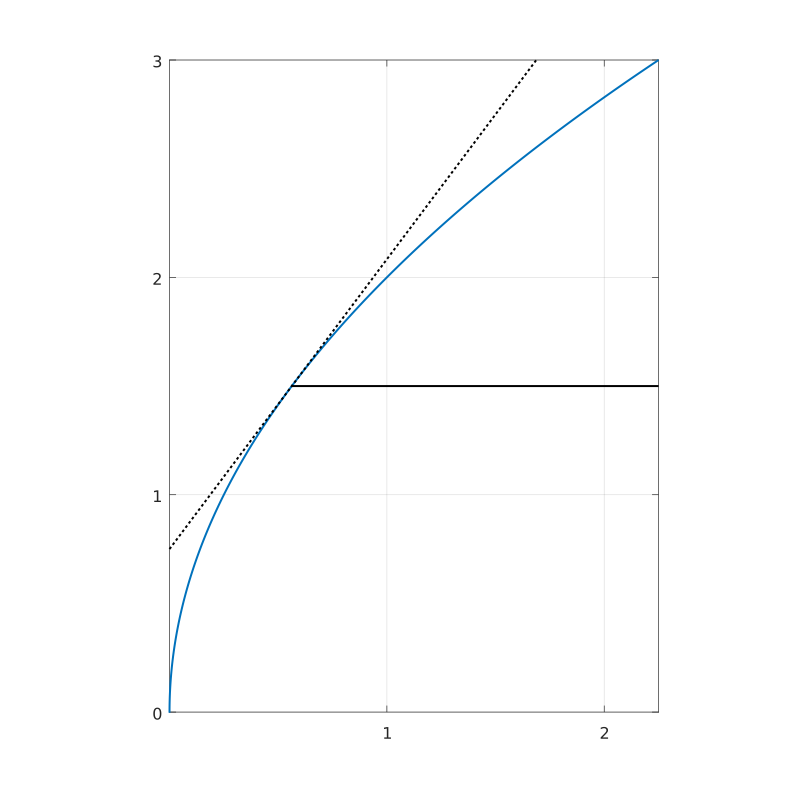 We draw the
perpendicular to this tangent. This is the axis about
which the incoming ray will be reflected.
We draw the
perpendicular to this tangent. This is the axis about
which the incoming ray will be reflected. 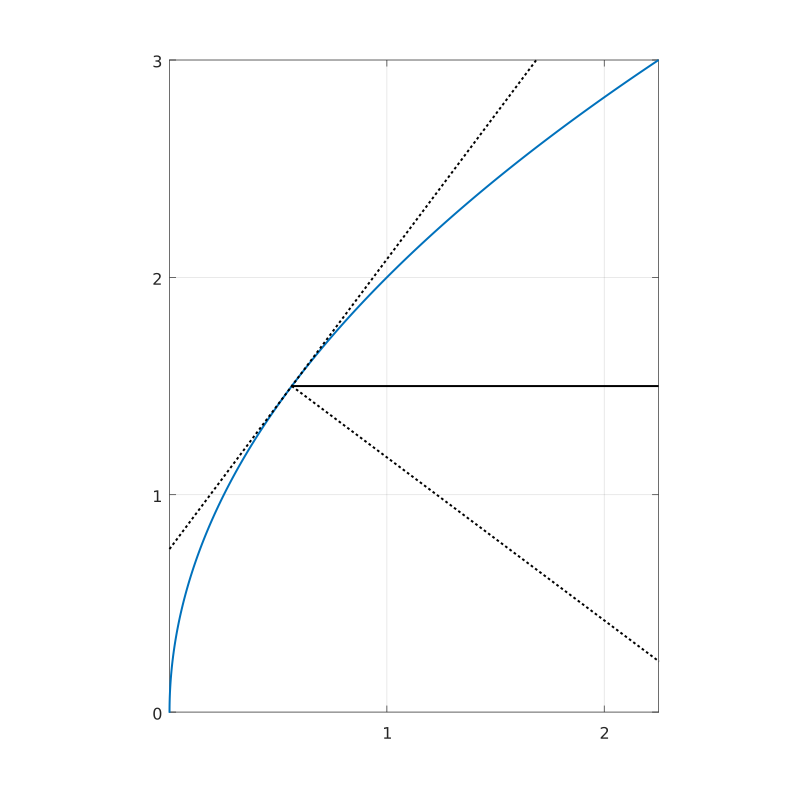 Finally, we can draw the
reflected ray:
Finally, we can draw the
reflected ray: 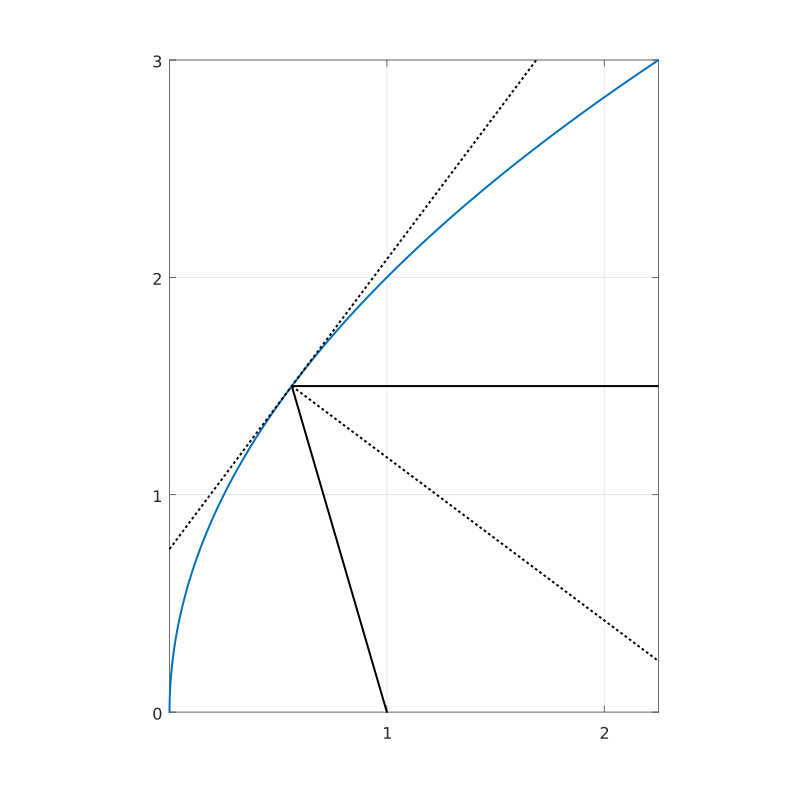 It does
indeed pass through the focus, as absolutely everyone knew it
would. But it’s pleasing to have a script that can take
essentially any incoming ray and plot it. Here’s for example a ray
coming in parallel at y = 0.5:
It does
indeed pass through the focus, as absolutely everyone knew it
would. But it’s pleasing to have a script that can take
essentially any incoming ray and plot it. Here’s for example a ray
coming in parallel at y = 0.5: 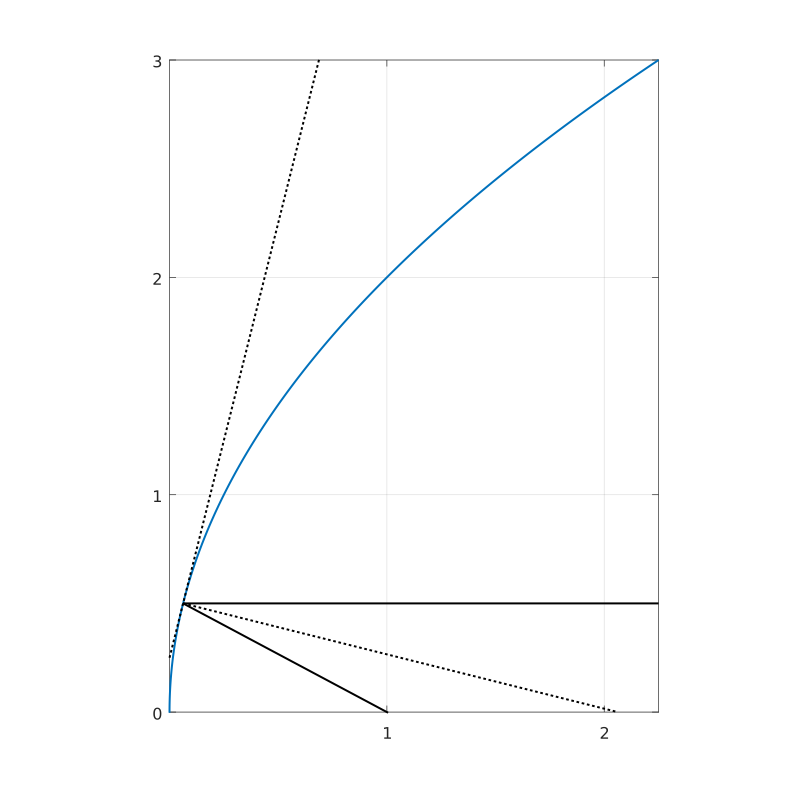 Codes below. I hope next
month to have an update on the real project.
Codes below. I hope next
month to have an update on the real project.
%% What is the error when using the simplified conversion between F and C?
clc
clear

% Default values
font = 'Cooper Hewitt Medium';
size = 11;
axSize = 12;
width = 1.5;

set(0,'defaultlinelinewidth',width);
set(0,'defaulttextfontname',font);
set(0,'defaultaxesfontname',font);
set(0,'DefaulttextFontSize',size);
set(0,'DefaultaxesFontSize',axSize);

C = -100:0.1:100;
F_real = 9/5.*C + 32;
F_approx = 2.*C + 30;
error = (F_approx - F_real);

figure
subplot(2,1,1);
plot(C,F_real);
hold on
plot(C,F_approx);
grid on
xlabel('°C');
ylabel('°F');
xticks(-100:10:100)
legend({'Real', 'Approximate'},'location','northwest')

subplot(2,1,2)
plot(C,error);
xlabel('°C');
ylabel('Error (°F)');
grid on
xticks(-100:10:100)
%% Does the parabolic mirror send all parallel rays through the focus?
clc
clear
close all
% PLOT DEFAULTS
font = 'Cooper Hewitt Medium';
size = 11;
axSize = 12;
width = 1.5;
set(0,'defaultlinelinewidth',width);
set(0,'defaulttextfontname',font);
set(0,'defaultaxesfontname',font);
set(0,'DefaulttextFontSize',size);
set(0,'DefaultaxesFontSize',axSize);
% DETERMINE THE PARABOLA
% --------------------
% y^2 = 4.p.x;
% --------------------
p = 1; % Focus coordinate on x-axis
y = -3:0.01:3;
x = (y.^2)./(4*p);
h = figure("visible", "off");
set(h, "units", "pixels", "position", [100 100 800 800])
plot(x,y);
hold on
% Plot properties
grid on
xlim([0,max(x)]);
ylim([min(y),max(y)]);
xticks(1:1:max(x));
yticks(min(y):1:max(y));
axis equal
% saveas(h,'parabolic-mirror-1.png','png')
print('-dsvg', 'parabolic-mirror-1.svg');
% INCOMING RAY
y0 = 0.5;
x0 = y0^2/(4*p);
line("xdata", [x0, max(x)],"ydata", [y0, y0], 'color','k');
ylim([0,max(y)]);
% saveas(h,'parabolic-mirror-2.png','png')
print('-dsvg', 'parabolic-mirror-2.svg');
% TANGENT TO PARABOLA
% y^2 = 4px
% ⇒ 2y.dy = 4p.dx
% ⇒ dy/dx = 4p/2y = 2p/y
m = 2*p/y0;
x_tgt = 0:0.1:max(x);
y_tgt = m * (x_tgt - x0) + y0;
plot(x_tgt, y_tgt,'k:');
% saveas(h,'parabolic-mirror-3.png','png')
print('-dsvg', 'parabolic-mirror-3.svg');
% PERPENDICULAR TO TANGENT
m2 = -1/m; % m1 * m2 = -1
y_perp = y0:-0.01:0;
x_perp = (y_perp - y0)./m2 + x0;
plot(x_perp, y_perp, 'k:')
% saveas(h,'parabolic-mirror-4.png','png')
print('-dsvg', 'parabolic-mirror-4.svg');
% REFLECTED RAY
% Angle of incidence and reflection are the same about the perpendicular
slope_angle = atand(m); % dy/dx = 1/4, and tan^-1(1/4) = slope angle
angle_of_incidence = 90 - slope_angle;
angle_of_reflection = angle_of_incidence;
% Now, the sum of the AoI, AoR and the SlopeAngle together make a 180° line.
% So, we can calculate the onward angle as:
onward_angle = 180 - angle_of_incidence - angle_of_reflection;
m3 = tand(onward_angle);
x_ref = x0:0.1:4;
y_ref = m3.*(x_ref-x0) + y0;
plot(x_ref, y_ref, 'k');
% saveas(h,'parabolic-mirror-5.png','png')
print('-dsvg', 'parabolic-mirror-5.svg');